
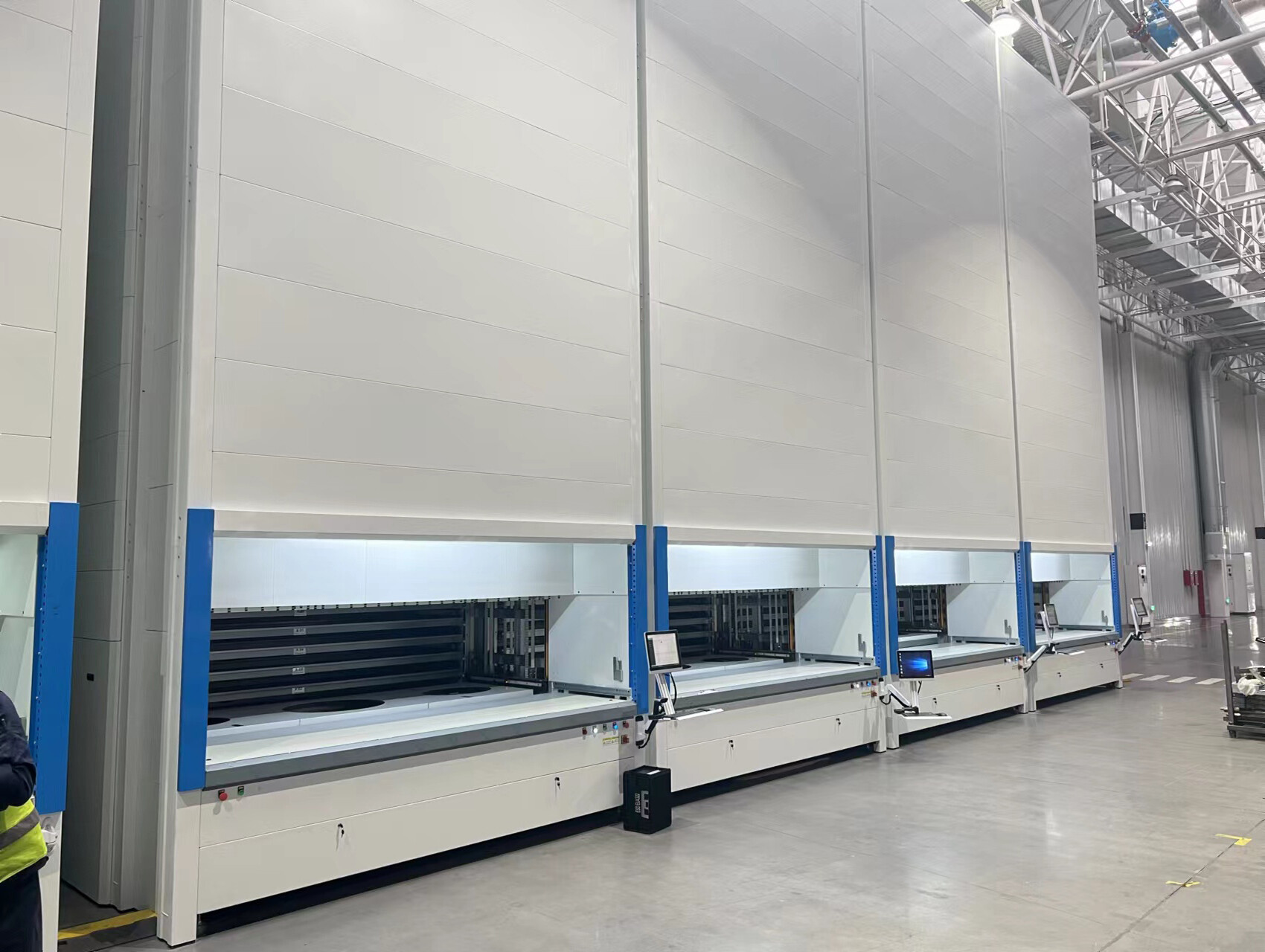
What Is A Vertical Lift Module?
A vertical lift module (VLM) is an automated storage and retrieval system that uses vertically arranged trays and a computerized inserter/extractor mechanism. These space-saving systems typically reach heights of 10-40 feet while occupying minimal floor space.
VLMs operate under the goods-to-person principle, automatically delivering requested items to an ergonomic work station. This eliminates manual searching and reduces worker travel time in warehouses and distribution centers.
Modern VLMs integrate with warehouse management systems (WMS) and enterprise resource planning (ERP) software, enabling real-time inventory tracking and automated order fulfillment processes.
How Vertical Lift Modules Work
The core mechanism consists of a vertical array of storage trays and a central inserter/extractor that moves vertically along the column. When an item is requested, the system calculates the optimal retrieval path and delivers the correct tray to the access point.
Advanced VLMs use dual-mast designs for increased stability and speed, with some models achieving retrieval times under 10 seconds. Load capacities typically range from 50 to 1,000 pounds per tray, accommodating diverse inventory types.
Modern systems incorporate RFID scanning, barcode readers, and weight sensors to verify picks and maintain accurate inventory records automatically.
Key Benefits Of Vertical Lift Modules
VLMs increase storage density by 60-85% compared to conventional shelving while improving picking accuracy to 99.9%+ levels. The automated retrieval process reduces labor requirements by eliminating manual search time.
These systems provide better inventory control through real-time tracking and reduce product damage by minimizing human handling. Energy-efficient designs consume less power than traditional conveyor systems.
VLMs offer flexible scalability - additional units can be added as storage needs grow without requiring major facility modifications.
VLM Classifications And Types
Standard VLMs are categorized by load capacity: light-duty (50-200 lbs), medium-duty (200-500 lbs), and heavy-duty (500-1,000 lbs). Specialized versions include climate-controlled units and cleanroom-compatible models.
Modular VLMs allow multiple units to operate as a single system, while standalone units are ideal for smaller operations. Some manufacturers offer hybrid systems combining VLMs with horizontal carousels or conveyor systems.
Recent innovations include VLMs with integrated robotic picking arms and AI-powered inventory optimization algorithms that automatically arrange items based on demand patterns.
Selecting The Right Vertical Lift Module
Key selection criteria include throughput requirements (picks per hour), inventory characteristics (size/weight), and facility constraints (ceiling height, floor load capacity). Evaluate the software integration capabilities with existing systems.
Consider future growth projections - modular systems allow easier expansion. Look for UL-certified safety features like emergency stops, light curtains, and overload protection.
Assess maintenance requirements and service availability. High-quality VLMs typically offer mean time between failures (MTBF) exceeding 50,000 hours with proper maintenance.
Industry Applications And Use Cases
VLMs are widely adopted in e-commerce fulfillment, manufacturing parts storage, healthcare supply management, and aerospace component handling. They excel in applications requiring high-density storage of small to medium-sized items.
In automotive supply chains, VLMs manage just-in-sequence parts delivery. Pharmaceutical companies use climate-controlled VLMs for temperature-sensitive medications.
MRO (maintenance, repair, and operations) facilities implement VLMs to organize thousands of spare parts while reducing inventory carrying costs through better space utilization.
Total Cost Of Ownership Considerations
While VLMs require higher initial investment than traditional shelving, the ROI typically ranges from 1-3 years through labor savings, reduced errors, and space optimization. Factor in energy consumption (typically 1-3 kW per unit).
Ongoing costs include preventive maintenance (1-2% of capital cost annually) and software updates. High-quality components extend service life beyond 15 years with proper care.
Consider the cost of downtime when evaluating different models - reliable VLMs maintain 99%+ uptime with proper maintenance protocols in place.
Future Trends In Vertical Lift Technology
Emerging developments include AI-driven predictive maintenance, IoT-enabled performance monitoring, and integration with autonomous mobile robots (AMRs) for end-to-end automation.
Sustainable designs are incorporating energy recovery systems and eco-friendly materials. Some manufacturers are developing ultra-high-density VLMs with 3D storage configurations.
The next generation of VLMs will feature enhanced machine vision for item recognition and blockchain integration for supply chain transparency, further revolutionizing warehouse automation.
Contact us